Saturday, 21 June 2014

Midsummer

"Green was the silence, wet was the light, the month of June trembled like a butterfly..." - Pablo Neruda

Morus_nigra
Mulberry tree (Morus nigra) in fruit
Light, butterflies, wet - we're having lots of all three apparently.  But I'm glad to say the earlier rain is now paying off in terms of fruit... prolific mulberries, small but succulent, their generous branching trees shading the waterside at our local port; raspberries are ready, apricots abound and cherries are almost over.
Wild plum


Christina has a passion for wild plums which we occasionally come across on our walks.  They're not much bigger than cherries and in a good year the poor trees are weighed down with them. We've been known to pick several kilos and religiously de-stone them before freezing them in bags for use in pies - cooked with star anise, they do taste quite like cherries with a pleasantly acid tang.

Xylocopa violacea (carpenter bee) on salvia
Carpenter Bee (Xylocopa violacea)
 on Salvia turkestanica
Our wet Spring has also led to an anticipated rise in the insect population.  We always have a few of these distinctive carpenter bees bumbling about but they are gentle giants of the insect world, far more interested in flowers than in humans. 

This year a couple of them have decided to nest in a length of bamboo used as a support for our tomatoes and you can hear them loudly munching their way through the inside of the hollow stick, prior to depositing their larvae within.  It looks like we've inadvertently supplied them with a 'des res' ...

Darter dragonfly
Dragonfly or 'libellule'
On a warm evening recently we were invaded by a host of golden dragonflies which must have just hatched.  They darted around like so many fairies with jewelled wings, delicately alighting on plants and sticks where they could admire one another and soak up the last rays of sunshine.  We'd just watered the beds with sprinklers, so maybe they were enjoying the moisture too.

Although we have a number of waterways and ditches around here, it's unusual to come across dragonflies or damselflies unless they're simply passing through. This brood of about 20 have stuck around for a few days now, entertaining us with their lively display.


Geum chiloense "Mrs Bradshaw"
Geum chiloense 'Mrs Bradshaw'
with pink Salvia and Californian poppies
In planting our borders we've tended to avoid using red flowers in case they clash with the various pinks and mauves already established. But we wanted to grow some Geum and couldn't find any with orange blooms, so I picked this RHS-approved strain which has bright scarlet flowers and really glows alongside its neighbours.

Now we've come to appreciate these vivid pinpoints of colour dotted around the garden like poppies in a meadow. Their erect stems provide a succession of flowers and I'm happy to report that they seem to be snail resistant too!


Geum chiloense "Mrs Bradshaw"
Hoverfly visiting Mrs Bradshaw
Scarlet is a much rarer colour in the butterfly world, but I snapped a Red Admiral looking distinctly dapper against the pure white blossoms of Escallonia macrantha.
 Red admiral on escallonia

Shrub of the Month

From being an unremarkable evergreen hedging plant, our Escallonia has put on a fair bit of new growth this spring and suddenly burst into flower about a week ago.  We also have a pink-flowering version but this one is much more striking and provides a thick hedge for the front of our rental cottage or gite.

Escallonia macrantha 'Alba' in bloom
with mulberry tree behind

We chose it to replace an ugly conifer hedge which had fallen prey to dieback and was clearly unhappy at being buffeted by salt-laden breezes.  It grows quite quickly and has attractive glossy leaves which stand up well to moist salty air and strong winds.  So far, it hasn't fallen victim to any of the other 'maladies' that beset hedges here and have their owners reaching for the Bordeaux mix!


Delphinium tatsiensis

One of the plants I grew from seed a couple of years ago was this delicate delphinium from Western China that almost got lost amongst our annual larkspurs which are distinctly more robust.  It has beautiful spurred flowers that last well and I'm hopeful that more stems will be produced as the plant matures.  

Perennials often demand patience but give them a couple of years to develop a good root system and you'll be amply rewarded.


Papaver somniferum and its seedhead
Annuals, on the other hand, are the floozies of the flower world - none more so than poppies which scatter their tiny seeds all over the place! 

Like so many people starting a new garden in a warm climate, I was looking for bold and exotic colour when we first came here. Poppies provide that hit of instant gratification, but their seeds linger a lot longer and still come to life whenever we turn the soil. Mostly I weed them out because the foliage can get big and untidy, but sometimes it's tempting to let one come to flower and just enjoy!  


The ex-potager has now become a herb bed, filled with colourful salvias and hyssops which are all flowering their socks off. Threaded amongst these are a few geraniums such as 'Ann Folkard' with bright magenta flowers which look good against the rough, purplish leaves of culinary sage.

Ann's finely-cut foliage is quite a pale green and also adds contrast to the surrounding herbs, so it's easy to see why she's one of the most popular geraniums for sun or shade. With stems of up to 60cm, she can hold her own at the front of the border without taking over.


Weed of the Week

Oxalis corniculata
Oxalis corniculata
This is another of those creeping things which look innocuous at first... you may well find it tucked into the corner of a flower pot or flashing its little yellow flowers at you from a crack in the paving. 

You might think it's a sweet little sorrel with bronze leaves, but don't be fooled - it's a Wicked Weed!! Those yellow flowers will produce capsules which ping out their seeds with great efficiency and the plants themselves can soon become entangled in the roots of your choicer specimens. 

Perhaps I sound a shade neurotic but I dislike anything which competes for the scarce moisture and nutrients in our soil. (Plus, of course, it just doesn't have a lot going for it aesthetically...)

An Aesthete keeping his eye on the herb border!


Thursday, 5 June 2014

Rich Pickings

"I must have flowers, always, and always" - Claude Monet

 Rosa versicolour
The delicate hues of Rosa versicolour
As in England, June is really the month for roses to come out in all their glory... and here on the coast it's sometimes the moment for a cruel wind to come and blast them off their supports!  Luckily we were forewarned of strong gusts in excess of 60kph and were able to pick a good display of the most vulnerable stems beforehand.
Roses with allium and foxglove
- painted by an 'Old Master'?


Although we'd had some lower branches lopped off our big ash tree last autumn, the weight of leaves was too much for another higher branch which had been thrashing back and forth in the gale.

I heard an ominous cracking noise during one particularly strong gust and ran indoors for car keys in order to move our Peugeot out of the line of fire.  Luckily the branch didn't actually break whilst I was underneath but it's a salutary reminder of how brittle our trees can become with age, even after all the rain we've had this year, and it's worth getting them regularly checked by a specialist.

We went to buy some wine from our local vineyard today and asked if the new growth had been damaged by recent turbulent weather, having seen how these winds can rip off young stems.  Fortunately their vines seem only to have been affected by the lack of sun and resulting pale growth... we live in hope that there's time for this to be remedied!


Cheddar_pink
Dianthus gratianopolitanus
Meanwhile, our garden still manages to put on a good show of colour and edging plants like campanula and pinks provide wonderful cushions of flowers and foliage.

Some types of dianthus make better 'mounds' than others and I particularly like this one which I grew from seed and is supposed to be the original 'Cheddar Pink'.  It has delicately fringed, deep pink flowers and is happy growing on dry limestone in full sun.

Now is good time to put pink cuttings in a very gritty compost - if you can actually find some non-flowering stems to use!


Another herb which provides vibrant flowers is a form of small leaved sage, Salvia microphylla, which is also suitable for container planting.  There's a popular variety with bi-coloured red and white flowers called 'Hotlips', but we prefer the single shades which are really intense and velvety in texture.

Here in this vase you can see two different kinds of red - one scarlet and one slightly more fuschia.  There's also one with creamy flowers and others in shades of blue, purple or salmon pink.


Linaria purpurea
Toadflax or Linaria purpurea

In the same vase are some blooms of purple toadflax, an unassuming but neat plant which grows just over a meter tall in semi-shaded areas.  It has attractive blue-grey foliage and an upright habit which means it can be useful for flower arrangements.

So far it appears to be fairly drought- tolerant and pest-free - all of which makes it a good garden friend and worth pursuing in seed catalogues to find out if there are other slightly more exciting varieties to be cultivated.


Delphinium_consolida
Larkspur flowering and in bud

A fine, upstanding type of delphinium is the annual larkspur which has seeded itself around our garden, together with good old love-in-the-mist (Nigella damascena) which has similarly light and feathery foliage.  

Whereas Nigellas tend to get too bushy and we end up removing most before they've finished flowering, the larkspurs form more open, branching plants which look quite stately in the border, particularly those with dark mauve blooms.  White and pink varieties are often sold in a mixed packet of seeds but these colours don't seem to come back as readily as the mauve which just goes on seeding itself in sunnier areas.


Salvia sclarea var. turkestanica
Several sages have come into bloom this month and I particularly enjoy the slow unfolding of petals or bracts on the Salvia sclarea opposite.  Its creamy, green and pink-tinged flowers will eventually be vertical  and the stems exude a distinctly grapefruit odeur on hot days!

Many sages are surprisingly scented, including some of the microphyllas mentioned above which smell of blackcurrants.  It's certainly a good reason for growing lots of different salvias in your garden and most of them are more ornamental than culinary, with quite a long flowering period.


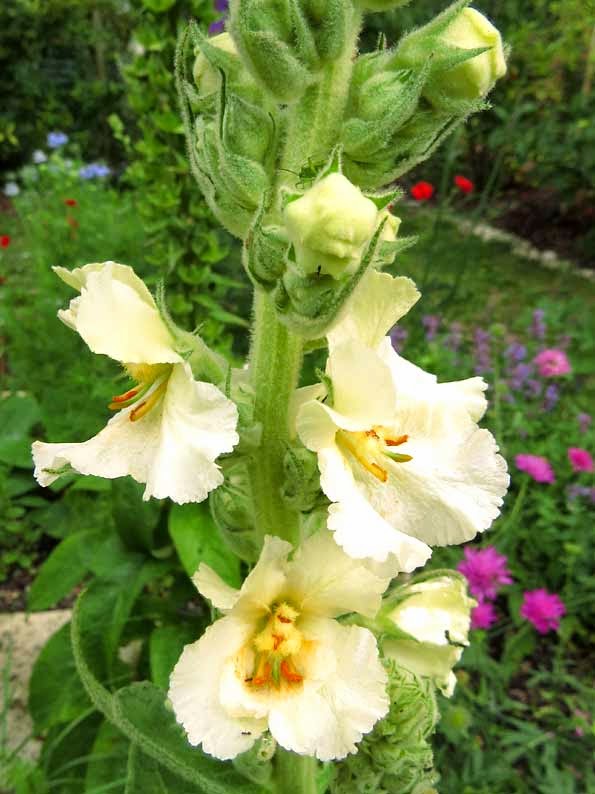
Verbascum hybridum "Snow Queen"
Verbascum hybridum
"Snow Queen"
We've come across verbascum apparently growing wild in chalky places around here, so it was a reasonably safe bet to try starting some from seed last autumn. I sowed these in pots originally and planted them out at the end of winter.

The first of these began opening its flowers last week, having reached a height of about 120cm, unlike the wild yellow ones we see which can be well in excess of two meters and rarely manage to stay upright.  I'm glad to say that its leaves, too, are fairly restrained and don't take up too much space.  Hoverflies seem to love them and the bundles of pollen remind me of miniature Easter chicks...!


On a more prosaic note, we spent an afternoon turning our compost recently as it's probably not been done for six months and we were in need of some rotted material to use as mulch.  We have a home-made bin under the ash tree into which we put our fruit & veg bits as well as most of our garden waste, all carefully cut up so that it rots down more easily.

If we had lawn clippings, the heap would warm up and make compost quite rapidly; but with a large amount of woody offcuts, it needs to be kept moist and turned at least once a year.  Once it's started to become dark and crumbly underneath, we dig out the bottom layer and put it in a plastic compost bin with a lid to finish off the process.

Close to the compost area, we came across this young tree frog relaxing on the leafy branch of a Cotinus bush.  Not exactly the best form of camouflage you might think, but then again he can squirt out a noxious liquid if attacked by a predator - as our cat has discovered in the past!


Reinette
Reinette resting on a smoke bush


Tuesday, 27 May 2014

April in May


foxgloves in garden
Dreaming spires of foxgloves
Don't be fooled by the deceptive tranquillity of this photo.  We took the precaution of staking our taller plants last week when the forecast showed that strong winds were on their way, accompanied by several thunderstorms and a scattering of hailstones...  

digitalis_purpurea_alba
Snail damage to stem
Since then we've had buckets of rain, along with gale-force winds, and our fairly pest-free garden is now full of snails 
and aphids which don't bode well for newly planted seedlings. 

Interestingly, one such snail almost chewed through the stem of this foxglove, but it survived anyway and continued flowering. 

Digitalis_purpurea_alba
Fresh growth
When I eventually cut off the main stem, the other side-shoots quickly took over and have now produced about ten healthy flowering stems.  

We already do an early 'chop' on our hollyhocks to prevent them getting too tall but it seems to work spectacularly well with foxgloves too and is probably worth repeating in areas where they get very wind-blown.  

As it's usually a strong healthy plant, I have to take a deep breath before wielding the secateurs so cruelly!!


Plants for shade

Osmunda regalis with Digitalis purpurea alba
Osmunda regalis with Digitalis
Having just watched the Chelsea Flower Show on TV, I make no apology for featuring white foxgloves at every turn! 

In fact we have pink and apricot varieties too, mostly self-seeded and usually in cool dry areas, although they also seem to do quite well in damp shade - as seen on the right, where a majestic fern clothes the wall behind it, revelling in rainwater which cascades down due to lack of guttering on the old barn.

This 'royal fern' - Osmunda regalis - is quite at home in sodden, chalky soil and now reaches a height of two meters.  It produces substantial 'flowers' or heads of brown spores, which I cut off so that the fronds can move more freely.
Lychnis coronaria
Lychnis coronaria

Another plant that seeds itself liberally is Lychnis coronaria, which can have magenta flowers (as shown here) or white ones which are even more effective in dark corners. This one is flowering under the canopy of a large ash tree but would be just as happy in a dry, sunny spot.

Similarly, there are many types of geranium - or cranesbill - which are able to prosper in sun or shade. They are often good for underplanting around shrubs
Cranesbill
and those with pale flowers look quite luminous in dark areas. If the soil is very dry then add a mulch of leafmould or some homemade compost after ensuring that the plant is well-watered.

Our ash trees provide a huge haul of leaves in the autumn and these are well worth sweeping up and keeping separate from the main compost bin.  This winter's heavy rain has ensured that our heap has been keep moist, with only the topmost layer drying out in the wind - lift that and you find dark layers of sticky leafmould underneath, damp and rich in worms.


Hedera_helix seedling with root

Hedera helix

Weed of the Week

Something else which finds itself right at home in shady corners is our old friend Ivy... much beloved by us English expats who associate it with decorated terracotta pots and crumbling brickwork.  Banish all such romantic ideas when entering a southerly climate!

I have zero tolerance for this ultimate thug which runs far too quickly under hedges, up trees and over walls, soon reaching heights where its flowers can't be controlled so the seeds rain down far and wide.  You can see from the tiny seedling above how efficiently it puts down roots even though its leaves are no bigger than my smallest fingernail.  Learn to recognise these two little leaves lurking in shade and uproot them immediately!
Oenothera odorata
Oenothera odorata


Returning to plants which have impact on gloomy days, I think it's hard to beat the evening primrose - the flowers of which open when sunlight fades or when the sky is overcast.

The lemon-yellow blooms last a day and then turn orange as they droop  Its erect stems are also tinged with red and stand out well against a green background.


As a member of the gaura family, it can develop a woody root after a couple of years and will probably need digging up, but it seeds readily and will doubtless pop up elsewhere.


Pittosporum tobira
Pittosporum tobira
Shrub of the Month

My nomination for a shrub which looks great and flowers well in late Spring would be Japanese Pittosporum tobira or 'mock orange'.  We don't have one in our garden but it's tolerant of sea winds as we just encountered it at La Rochelle, where it was blooming profusely along dense hedges in the shoreside park.

The tough, glossy leaves are suited to full sun or part-shade and its creamy white flowers have a similar scent to orange blossom. We first noticed it whilst on holiday in Greece where it was planted around a swimming pool and kept very neatly trimmed... well worth noting for poolside planting!  This evergreen shrub is also recommended by the RHS, who say it needs just light pruning and a mulch with compost.

We're almost into the month of June now, hoping that our weather will finally settle down to those long hot days of Summer!


Lavender border starting to fill out,
 with Campanula lactiflora flowering in background


Monday, 12 May 2014

A Merrie Month

The long-awaited season of plant fairs!

However much we try to anticipate our planting needs by growing new things from seed, there is always the irresistible lure of a good plant fair, even if it means driving south of Bordeaux to an area notable for 'Graves' wine.  Luckily it was a fine and sunny day, so we packed a picnic and primed the Satnav accordingly.

Here in France it's usual to have at least three bank holidays in May and this year they all happen to be on Thursdays, which means many people escape for a long weekend and descend on the countryside.  So, no surprise to find the fair at Saucats was jam-packed with browsers when we turned up at about 11am, and it was difficult to move around the stands, let alone attract the attention of a vendor when we wanted to make a purchase.
Viburnum sargentii 'Onondaga'

Shrub of the Month


Nevertheless, it didn't take us long to pick out a few hardy geraniums - based on the principle that you can never have too many - and we also fell for a rather handsome shrub which hadn't been on our wish-list but will probably find itself a space in our back border.

As soon as I saw its lacecap blooms, I remembered admiring this viburnum in a Bressingham's catalogue some 25 years ago when I was planting up a garden in Hampshire and knew next to nothing about shrubs.  I had so many plants on my list that I simply couldn't afford an extra specimen piece, but its name has stayed with me all this time and, luckily, Christina was similarly entranced.


Viburnum sargentii 'Onondaga'
In addition to the attractive florets, its leaves are an unusual shape and can be maroon when they emerge, turning green as they mature and then going red once again in autumn.

As it's in a pot, we've temporarily placed it next to our newly-painted wall which seems to complement the colouring.  (For any decorators out there, this shade is known as "Terre d'Egypte" on Farrow & Ball's colour card!)

 Paint it Black

Lavender border
Judicious use of colour can have a dramatic effect in the garden, lengthening perspectives and helping plants to stand out.  Christina's just finished adding a mulch of oyster shells to our new lavender border which is, in effect, a raised bed on the gravel driveway.  The existing border was a bit too narrow but it had already been designed using concrete edging stones which are difficult to remove, so we just added a new strip of planting and offset it with a black-painted wooden edge which contrasts nicely with the white shells.  

It remains to be seen whether Couscous the cat will try digging his way through this oyster mulch...!!


Daisy grubber and wicked weed

Weed of the Week

Mulching is a good way to keep some weeds from seeding into bare soil, but there will always be those which creep up from below - like our little friend on the left which must be part of the strawberry family, although I've failed to find it in my wildflower book.

It can be very invasive and difficult to remove, so it's worth investing in a good 'daisy grubber' of stainless steel which can easily slip under the rooted runners, causing minimum disturbance to other plants.
Digitalis_purpurea_alba
Foxgloves under a deutzia

The shadier, woodland part of our garden is gradually coming to the fore now that it gets early morning and evening light.  The over-arching stems of a deutzia bush are starting to bloom and create a kind of bower over the romantic foxgloves.

Now here's a plant which, to me, looks wonderful in all stages of development... as long as snails and wind don't attack it. Most of ours, in various shades of pink and white, have seeded themselves in suitable spots and seem to be pretty self-reliant.  

Occasionally, I'll move a plant to a more open position while it's still small, so that we can observe its stately beauty from all angles - and sometimes this means that a tall specimen will need staking against the wind.  They do so well in our chalky soil that they often grow to more than two meters.


Orlaya grandiflora
Orlaya grandiflora
Another flower which is equally suited to woodland or prairie-style planting is the gentle Orlaya grandiflora, also known as White Laceflower or French cow parsley. Like foxgloves, this is also quite slow to develop and can be admired en route to its final flush.

Here it is just starting to open up next to an evening primrose which is still in bud. These little umbellifers are easy to grow from seed and mingle happily with bolder plants such as blue geraniums, yellow oenothera, scabious and viper's bugloss, eventually giving the effect of a glorious Mediterranean meadow.


Knautia macedonia with aquilegias
Aquilegias with Knautia macedonia
Other flowers which mix well and are worth picking to admire at close quarters are the nodding heads of aquilegia and the pincushion blooms of knautia, which is a form of scabious.  Whilst dead-heading the latter, I realised their furry  seedheads would look just as attractive as the flowers themselves and were worth adding to the vase.

We've already been cutting roses to bring indoors and in places the hedgerows are festooned with delicate dog roses.  This is the flower known as eglantine in French - a word which somehow conveys its effortless elegance!


Rosa canina or Dog Rose
Rosa canina


A recent walk along the shore whilst collecting oyster shells, revealed that clumps of yellow horned poppy have seeded themselves along the recently re-made coastal path that often gets washed away in violent storms.
Glaucium flavum
Glaucium flavum


We first saw this poppy growing wild in Crete and you have to admire its resilience in braving cold winds and salt spray.  I'm delighted to have found a local colony and its glaucous foliage looks very much at home amongst a natural garden composed of sea holly, kale and oyster shells.

The shores of the Gironde estuary have been well-managed on the whole and care is taken to preserve much of its natural flora which is constantly at risk from tidal erosion and inevitable tourist incursions. 

A good deal has been spent on providing proper paths for walkers and cyclists so that there's less incentive to stray off the beaten track.


A carefully-managed honeysuckle climbs up the Egyptian wall...!


Saturday, 3 May 2014

Planting Architecture

Billowing cow parsley down our back lane

How we moaned about the seemingly endless rain we endured in early Spring... and how magnificently we've been rewarded with flowers and blossom ever since!  The eager-beavers who normally strim our roadside verges, practically to extinction, have kindly left a good swathe of cow parsley for us to enjoy and this year our lanes might even rival those of Devon.
Hogweed (Heracleum sphondylium)
Hogweed
(Heracleum sphondylium)


But nature also loves a contrast and has counteracted all this delicate froth with some seriously structural plants such as hogweed and angelica, which are also burgeoning thanks to the extra rainfall. 
I would say there are ten times as many of these giants as we usually get around here and doubtless they'll lead to an explosion in the insect population as well.

So, what occurs naturally in the landscape gives us ideas for our gardens... growing a sculpted form amongst softer, less defined flowers; choosing plants which contrast in colour as well as in shape.

Sometimes a plant will be more defined in the early stages, before it actually flowers.  I noticed this recently with the Campanulas which are just beginning to open their mauve bells.
Campanula lactiflora

In early-morning light, their ribbed flowers are almost more attractive in bud than when they are fully mature and forming a lilac drift with their companions.  (Would it be blasphemous to suggest that some plants are better in anticipation than at the height of their flowering??)


Take a packet of seeds ... 

Another interesting perennial, in terms of both leaf-shape and flower, is the Aquilegia - which comes in many sizes and colours.  A few years ago we scattered a pack of seeds and enjoyed an amazing display of McKana Giant Hybrids, growing well over a meter high, with blooms in bright mixtures of yellow, red, blue and white.  
Aquilegia McKana Hybrid


They were truly eye-catching and did come back quite well the following year; but then, alas, their foliage started to be eaten up by caterpillars and the plants never looked quite as robust or stately as before.

Determined not to be beaten by pests, I grew some Aquilegia alpina from seed and these have now matured nicely.


Aquilegia alpina
Aquilegia alpina
My Chiltern Seeds catalogue says it's "the true wild Columbine of the Alps" and so far its attractive blue-green leaves haven't been attacked by caterpillars, which just goes to show how a slight change in species can deflect an insect-invasion!

But, exquisite though it is, a part of me still longs for the outrageous flamboyance of those McKana's...

A packet of seeds is probably the price of one plant sold at a garden centre, so why not experiment with different varieties and give some away to your friends?  We don't have a greenhouse but find that a cool window-sill and/or a small cold-frame is enough for growing dozens of plants.  You just need to be on hand to keep them watered and potted-up... a bit like having pets really!


Papaver rhoeas or Shirley Poppy
Papaver rhoeas

Of course some plants are easier to grow than others and you might think that poppies would be the easiest of the lot.  The Californian type aren't difficult, provided they have free-draining soil and sunshine; and you'll never be without opium poppies once they've set seed in your garden.  (Christina makes me pull them up because their leaves get too big and untidy!)

But the exquisite Papaver rhoeas or Shirley Poppy, which is so delicate in form and colour, can sometimes be tricky and needs to be sown at just the right time.  This year the mild winter prompted me to start seed trays in February, but normally it's better to wait until early April when sunnier days lead to faster germination and sturdier plants. 

Things inevitably flower earlier in our south-facing cottage garden which is now strewn with the white petals of Cistus and Geranium kashmir which come out at the same time.   This is probably our favourite Geranium as it's shade-tolerant and happy in dry spots, making it ideal underplanting for shrubs such as cistus and hibiscus.


Cistus lusitanica and Geranium clarkei 'Kashmir'
Cistus lusitanica and
Geranium clarkei 'Kashmir'

I hasten to add that this wasn't a geranium I grew myself.  It's a family which produces very tiny seeds which are difficult to collect and handle generally.  Once you've established a container-grown specimen in your garden, it's easy to dig up rooted pieces whenever the weather is mild and damp enough for transplanting.  This is a free-flowering variety which makes excellent non-invasive ground-cover.


Foliage shapes

Although we have an abundance of flowers to look forward to, it's equally important to fill your borders with interesting foliage - bearing in mind that this is what you'll be looking at for much of the year.  

This picture demonstrates the effect of low light shining through young plumes of fennel and the newly-formed seedheads of honesty, at the same time reflecting off the bronze foliage of a Carex grass which provides colour contrast.

Whilst I would definitely nominate Cistus as Shrub of the Month (in our garden, for early May at least) I think that many of the wisterias around here would qualify for that accolade.   We'd undoubtedly grow one ourselves if we had more space and, vitally, if we had a solid structure to support it.  Pruning can also present a challenge if they grow higher than two meters!


Wisteria_sinensis_alba
Wisteria sinensis alba
Last week we passed this lovely white version clothing the corner of a traditional Charentais cottage in one of our nearby villages.  The racemes weren't fully out yet but looked extremely graceful against the mellow stonework and blue shutters.  

We've often thought it would be perfect to have a "ruin" in the garden over which you could drape such a magnificent specimen!

Meanwhile, we have to make-do with a frequently pollarded mulberry tree... 
...and a cat who likes to drape himself!
Our Shrub of the Month actually comprises two types of Cistus, flowering in the front walled garden where they are protected from frost and get a good baking in summer.  I think the one with magenta blooms is Cistus x pulverulentus 'Sunset' - it has downy grey leaves which are strongly aromatic in the sunshine; while its white-flowered cousin is Cistus lusitanica 'Decumbens' which also has appealingly crumpled petals but doesn't have such scented leaves.


Cistus lusitanica has borrowed a 'stripe' from
its neighbour Cistus x pulverulentus!