Friday, 27 March 2015

Damp Days

"None can have a healthy love for flowers
unless he loves the wild ones" - Forbes Watson

Blackthorn (sloes) on the Gironde Estuary
A garden opening onto the marais

All this wet weather is certainly good for one thing: blossom! Blackthorn in particular seems to have outdone itself this year and the salt marshes are bounded by many hedgerows such as this one. (It makes up for the sad fact that other field hedges have been ripped out by local farmers seeking to maximise their yields.)

Pussy willow or Salix
Willows have also provided a host of catkins this spring and out on the marais we passed this beautiful "sallow" tree which, unusually, was not part of a hedgerow.

Sallows have fluffy catkins, or flowers, that are held almost erect rather than drooping down; these are the pussy willows which are often used to decorate churches on Palm Sunday.


Spring arrivals


Birdwatching along the estuary
At this time of year, the Gironde Estuary is a good source of birdlife as there's a mixture of habitats along its banks and no shortage of water!

In the past ten days, we've seen both hoopoes and swallows arrive on our shores whilst we were busy chasing elusive penduline tits (see my last post).

A well-earned rest!

We usually record the first swallow in mid- March but this one was photographed on the 21st, which might indicate they were a bit late arriving. On the other hand, we might simply have missed the early birds... Christina acts as chief 'spotter' striding out in front, whilst I bring up the rear with my camera, often trying to focus on a moving target. 

Celastrina argiolus
Celastrina argiolus
On a brighter morning, we spied another harbinger of spring - a blue butterfly which I think is the Holly Blue, even though it was soaking up sun on a bay leaf. 

Whilst holly is quite a rarity down here, bay trees are ubiquitous: very tough and fast growing, they are best avoided in the garden. (Their small, culinary cousin is absolutely fine however.)

This butterfly was spotted on the edge of some woodland which borders a vineyard and provides another fertile habitat for birds and insects.

Sloes (blackthorn) blossoming at the woodland edge

Meanwhile, back in our garden we've enjoyed watching the first blossoms on our small peach tree unfurl their petals.

Prunus persica
Prunus persica
We grew this from a stone a couple of years ago and, much as I love most types of Prunus, I wasn't particularly keen to plant this one in our garden. This is mainly due to the fact that it needs spraying now in order to prevent unsightly leaf-curl later on.

Christina, however, is not so squeamish when it comes to wielding the Bordeaux mix (copper sulphate) which is what our neighbours seem to use, and she gave the tree a couple of preventative sprays on those rare days when the wind wasn't blowing. 


Colour after the crocuses have gone...


Chionodoxa forbesii "Pink Giant"
Chionodoxa forbesii "Pink Giant"
This pretty little bulb produces starry pink-to-lavender flowers which are reminiscent of a hyacinth, with similar fleshy leaves.

It originally came from the mountains of western Turkey and there are varieties from other areas with bright blue flowers which would also be worth having. They bloom early in the year and soon get covered by plants such as forget-me-not, so foliage die-down is not a problem.


Tulipa turkestanica
Tulipa turkestanica
Another exquisite early bulb is this tiny tulip with multiple heads and arched stems which gives it the appearance of a lily. 

Once those petals open, however, it turns into an attention-grabbing star with a distinctly sunny disposition! Planted last autumn, these clumps already seem well-established.


Tulipa turkestanica
T. turkestanica opening to sun
These species tulips come from Central Asia and I love the fact that they look wild  and combine happily with other delicate plants, perhaps grown around the base of a fruit tree or in a rock garden.

Like most bulbs, they need good drainage and plenty of sun, so avoid putting them in areas which will require heavy watering in summer. 

Other species worth having are Tulipa praestans (scarlet, flowering April) and Tulipa clusiana with grassy foliage (pink, streaked white, also flowering in April).


Although primroses are traditionally pale yellow when found in the wild, and we have several clumps planted under hedges, I deliberately grew some blue primulas from seed just to introduce another colour into the spring border.

These have been flowering for at least a couple of weeks now (in places where the birds haven't nibbled their buds!) and their petals seem to change from blue to violet depending on the light.


Before and After
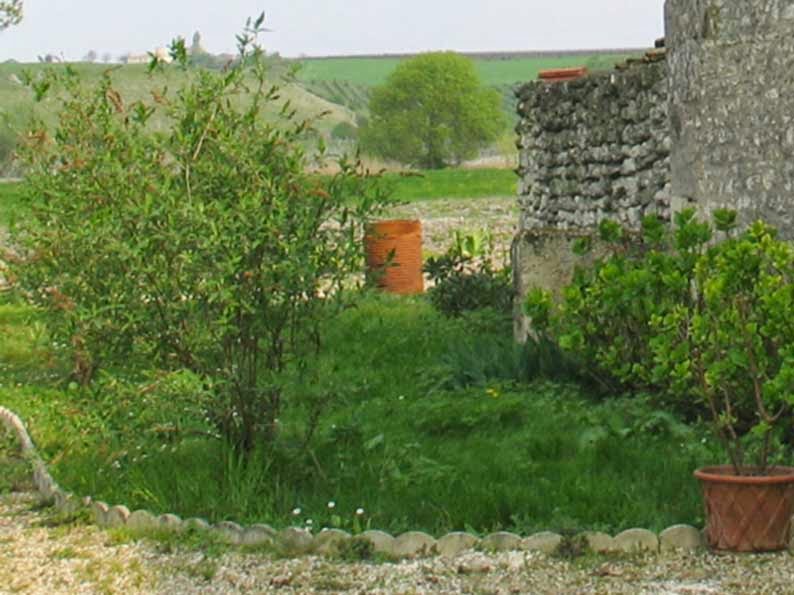
 

Back garden in 2003 
Delving into the archive once more, this is a view looking towards our neighbour's driveway and fields beyond.  At the time of moving here we inherited a couple of buddleias and some mop-head hydrangeas which have long since gone, replaced by viburnum, daphne, deutzia - and some rather more subtle forms of hydrangea.

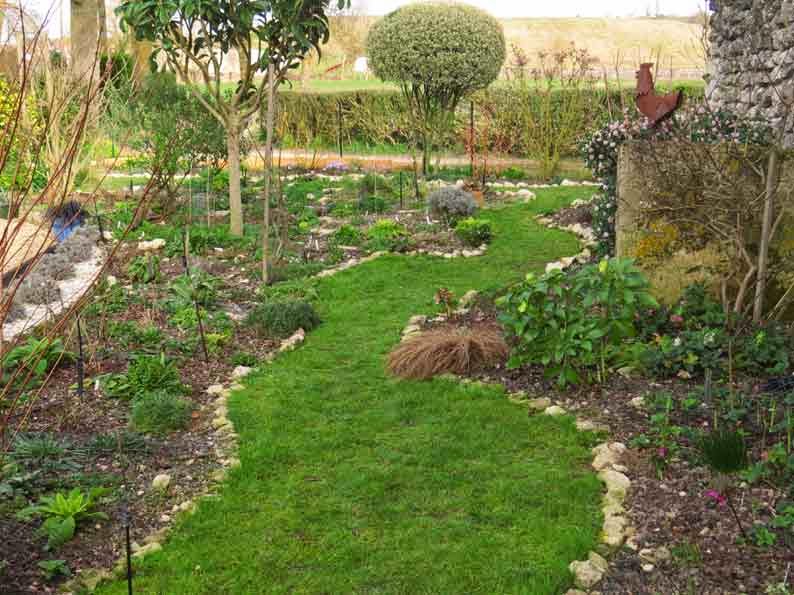
Bigger borders and less lawn in March 2015
Yes, a lot has changed in twelve years and - being so English - we've certainly packed in a multitude of herbaceous plants!

Chalk cliffs surrounded by reed beds on the estuary


Monday, 16 March 2015

Small is Beautiful


"Nobody sees a flower really, it is so small.  We haven't time, and to see takes time - like to have a friend takes time." - Georgia O'Keeffe

Salt marsh on the Gironde Estuary


Some things, like the estuary with its tidal streams and brackish lakes, are simply too big at this time of year, and prone to overflowing.  Later this March we face the prospect of an unusually high spring tide which might even reach into our garden... un vrai catastrophe for the plants, few of which would be salt-tolerant.
Penduline Tit

That said, the reed beds of the marais do a good job of soaking up excess water and are beautiful to admire on a sunny day when you can look down on them from one of the nearby chalk cliffs.

Amazingly, in all the time we've been watching shore birds, we've never managed to glimpse a marsh tit; but this week we did come across a lively family of penduline tits (Remiz pendulinus) darting around an area of scrub bordering the reedbeds. Tiny and beautifully marked, they're fairly rare visitors who over-winter in certain parts of southern Europe.


Slender Speedwell (Veronica filiformis)
with a Rough Hawk's Beard 
Meanwhile, on the ground, wild flowers are starting to emerge from dormancy and this fetching combination of sky-blue speedwell and sunny yellow hawk's beard (Crepis biennis) is a common theme in the vineyards.

After so much rain, we've finally had ten days of dry, windy weather which has shaken some of the mud off the hedgerows.


When it comes to our own hedges, Christina is very particular about tidying up the space beneath them, taking out weeds and leaving space for a few early flowers such as primroses. To give them a bit more light, she snips off any messy lower branches of hedging - in this case Viburnum tinus, which is also underplanted with miniature daffs and edged with the ever-reliable Campanula poscharskyana.

You can also see evidence of our watering system running at the back of these plants - it certainly aids the establishment of new hedges as they get their roots down.


Mimosa (Acacia dealbata)
- an ephemeral beauty!
During those cold wet days of early spring it's uplifting to have some indoor bulbs, in order to savour the very moment when their tight buds unfurl into waxy colour, unsullied by any mud-spatter or animal munchings!

And it's great when a friend turns up for lunch bearing a fresh swag of mimosa which releases its haunting almondy fragrance as soon as you remove the cellophane from its blossoms

We adored it for two whole days before our central heating started to wizen its tiny puffballs and its perfume gradually faded into nostalgia.


Shrub of the Month
Loved for its foliage as much as its blooms

Mahonia aquifolium

This is the low-growing spreading form of 'Oregan Grape' which is worth having for its leaves alone. It provides contrast to other evergreens by putting on a show of glossy foliage in late February to March, followed by clusters of yellow flowers which attract bees and other insects.


Fresh leaves on Mahonia aquifolium
I really enjoy watching new leaves emerge on this shrub and the range of hues is more akin to autumn than spring, useful for adding to cut flowers in a vase.

We also have the taller Mahonia japonica, with less impressive foliage but giving us beautiful sprays of scented flowers in the middle of winter. Both versions need careful clipping and pruning to keep them looking their best but otherwise are easy to maintain.


Wicked Weeds and other Pests
Shepherd's Purse
(Capsella bursa-pastoris)

Regular readers will know I'm paranoid where weeds are concerned. Let's face it, their main aim in life is to take over your garden, by various means of stealth and deceit, and we have to get them before they get us!

No one is more cunning than this delicate plant that insinuates itself wherever there is enough nitrogen in the soil... pretty much everywhere in our garden. It then abuses your hospitality by firing out seeds in spring-loaded capsules, trying to catch you in the eye just as you're leaning over to yank it out.

My advice is: Grab it now - before its innocent little flowers have a chance to to form!

Caterpillars of the
Pine Processionary Moth
Although weeds might drive you nuts, they tend not to affect your health in other ways; whereas the caterpillars on the left, having emerged from their web-like nest on a warm day, pose a very real threat to pets who could ingest and choke on their irritating hairs. Humans, too, can suffer allergic reactions to touching them.

Many of our neighbours have these moth nests clearly visible in their pine trees yet seem to do nothing about them. Luckily, there's plenty of information on the internet about how to get rid of this pest.

On a happier note, Christina had a moment of real triumph yesterday whilst engaged in the rather unenviable - but necessary - task of turning the compost heap.

Halfway down she unearthed her favourite weeding fork which had probably lain there for the past six months, feared lost forever, with its nice wooden handle now showing signs of having been nibbled by a rodent.

The day before she found a 'diamond' ring in the road whilst sweeping up some rubbish... who says the righteous don't get their just reward in this world?? 


Crocus amongst Cerinthe leaves
Amongst the small gems of our springtime garden, we have to celebrate the clusters of crocus which have multiplied in sunny spots where the originals were planted years ago.

They look delicious on a damp day, when speckled with rain or dew, petals folded protectively over their downy stamens. Their leaves are discreet but clearly striped to mark them out from other bulbs.

Then, when the sun finally deigns to shine again, whoosh... up they come to savour the light, greedy with desire, their translucent stems transmitting energy like filaments.

It's a flower that punches above its weight in the garden and seems to encapuslate our own deep-seated longing for sunshine and heat.

Last year we planted several of the Dutch 'striped' hybrids at the front of our new raised bed and they look particularly effective against a carpet of oyster shells.


'Pickwick' crocus flowering in the herb bed

Monday, 16 February 2015

Frost and Ice

"I prefer Winter and Fall, when you feel the
bone structure of the landscape...
something waits beneath it, the whole
story doesn't show"  -  Andrew Wyeth


An icy north-easterly blows over our hills and valleys, exposing the limestone carapace of an ancient land. This is a favourite part of our village, or commune, where we regularly go walking and bird-watching.  In summer these hills are painted yellow with sunflowers; occasionally in winter the Gironde Estuary floods right up the valley where you can see it shaded in green.
vineyard_snow
Vineyard on the banks of the Gironde

But this is also a land of venerable vines, particularly on the other side of the estuary where some of the finest Bordeaux vineyards are situated.

These vines are sleeping now, having been given a good prune by our neighbours and the other seasonal workers who are out in all weathers, muffled up against the elements. They are the real heroes of the wine industry, who we silently salute each time we raise a glass of our local red!

Although the wind-chill can be cruel, and gales can wreak havoc in the garden, we get little in the way of snowfall.  A light dusting the other day got me up early with my camera but it was all gone by lunchtime.

Sometimes the temperature can start below freezing and climb fifteen degrees during the course of a morning so you can be sunbathing in a sheltered spot by afternoon.

Palms on a roundabout
You'd think it would be difficult for mediterranean-type plants to cope with these fluctuations but many of them, like these date palms in Royan, don't get wrapped up for winter and seem to survive quite happily, helped by their proximity to the sea. 

Plants kept in pots are at greater risk of having their roots frozen and it's always important to make sure that your soil is free-draining - those lumps of chalk in our earth are actually quite handy!


Helleborus niger
Helleborus niger
Hellebores are coming back to life now, unfurling their glossy toothed leaves and opening greeny-pink buds to disclose their secretive, downturned flowers.

Ours have been interbreeding for a few years, producing endless variations on a theme of green and maroon, some having more pronounced stippling on their petals and some with beautifully contrasting stamens.


It's well worth picking a few blooms so that you can admire them up close in a vase.


Daphne odora
Daphne odora with twigs of Cornus 
Having said that, we've been enjoying small selections of Daphne on the dining table in recent days.

At the end of January she starts proffering her scent-laden blooms and carries on flowering through February when there's precious little to enjoy in our shady back border.

Cornus alba or Dogwood is also a useful shrub in the garden at this time of year when its bright stems really light up a border.  Its flowers are inconspicuous but the stems come in various shades of red or yellow depending on variety and need to be cut down in spring so that new, colourful growth will grow back in time for next winter.


Salix alba as garden sculpture
Dogwoods are similar to the willow trees (Salix alba) which we have growing in marshy areas and along river banks. They, too, need to be pruned hard to encourage new stems and the offcuts can be used to make hedging as they root so easily in damp soil.

Where the offcuts are a good length they can be planted and interwoven, as illustrated here by a willow-arbour which was created last year in our friends' garden.  (I've yet to see this one in leaf but will try to get another photograph in summer to show how it develops.)


Viburnum tinus
Viburnum tinus - handsome and versatile
Shrub of the Month
Viburnum tinus

This is an evergreen which thrives in the shady border and which we've used to partially obscure our plastic water-butt. Recently we've also planted it as a low hedge down the back lane and it is dense enough to give privacy whilst also providing attractive flowers in winter.

Here it's being grown as a specimen shrub in a French garden: allowed to develop without much pruning, it nevertheless shows off a lovely array of pink buds opening into white starry flowers which contrast with the glossy foliage.

Caro in the cottage garden - April 2003

Down memory lane...

Going through my photo archive recently, I came across a few pictures of the garden as it was when we first arrived here over ten years ago.

I thought it might be interesting to show what we decided to keep and how it has matured during that time.

In this photo it is only the mulberry tree which remains, although you can see that its trunk is much sturdier now.

We enlarged the bed around it and underplanted with creeping thyme (on the left) and a mixture of bulbs and perennials, interspersed with grasses to add movement.

The mulberry provides a good shade canopy in summer, so the trick is to grow things which can survive in hot, dry and shadowy conditions ... not an easy combination!

As it's the garden for our lettings property, we wanted to have plenty of colour without too much maintenance. Gone are the floribunda roses - and numerous hollyhocks, which flourish elsewhere in the garden.

Certain things like this nemesia (or is it diascia?) came in a pot from the UK and we used it as edging because the pink flowers smelt of vanilla. It has continued to grow and seed itself ever since, being a perennial in this climate.

Californian poppies and cerinthe also seed themselves liberally in this bed. Other perennials here include salvia microphylla, verbascum, lavender and geum.

If anything, the sandy soil in this part of the garden is a bit too fertile and now is the time when we spend a back-breaking hour or two removing as many weeds as possible before all the bulbs come up. It's time well spent, even on a cold day when you can manage a mere twenty minutes before rushing inside for a nose-blow and a hot cuppa!


Thursday, 29 January 2015

Winter Dreams

"A flower blossoms for its own joy"
- Oscar Wilde

Rudbeckia hirta 'Prairie Sun'

Here, in the depths of midwinter, one can be seriously short of sunshine and joy.  Traditionally it's time to reach for the travel brochures or, if you're like us, a gardening catalogue full of old favourites and new introductions. In my case, it doesn't even have to be illustrated - just a comprehensive guide with colourful descriptions will do fine!

Rudbeckia hirta 'Prairie Sun'
Emerging in early July
At the same time, a review of our photo's from last summer serves as a reminder of why we chose certain plants to cultivate from seed.

This particular 'prairie flower', Rudbeckia hirta, was a pleasure to look at in all stages of development: upright and sturdy, it added structure to a vase and lasted for several weeks in the garden.

Apart from having bicoloured petals, its central cone also morphed from pale green to gold as its stamens gradually emerged and spread up from the base.


Rudbeckia hirta 'Prairie Sun'
Maturing in mid-August
This third picture reveals the flowers in their maturity, looking a little more like the familiar 'Black-eyed Susan', but stronger and more defined in shape.

They were easy to grow from seed in early spring and provided us with a host of blooms just a few months later. 

I'm still finding out which perennials are better sown in autumn, and planted out to over-winter in the garden - like wallflowers - rather than being sown in spring for transplanting when the soil warms up.
 cold-frame
A simple cold-frame with perspex roofing
provides enough protection in winter


It really depends on how well they can withstand cold, wet weather or attacks by slugs and snails when they are still quite small.

You might think, for instance, that Echinacea would be tough enough to survive winter in the border, yet they have an unnerving habit of disappearing underground and becoming lost.

Now I mark each little plant with a stick so I can keep an eye out for emerging leaves and don't dig up the crown by accident.


Dianthus barbatus 'Homeland'
The type of dianthus here - better known as a Sweet William - was grown from seed last spring and several were then transplanted in summer. 

One plant managed to flower well, whilst the others have yet to perform even though they seemed to establish at the same rate. It's not always certain that perennials will bloom in their first season but I think that just adds to the anticipation of a grand show the following year!


Campanula carpatica
Campanula carpatica
Other seeds from last spring which have yet to produce flowers include Phlomis samia, Penstemon digitalis 'Husker Red' and Dianthus superbus. But they've all clumped-up nicely so should really take off this year.

The little Campanula carpatica was easy to grow, like most of its harebell family, and produced a succession of blooms from early July - a bit later than I'd have expected but no less welcome.


Nicotiana alata 'Lime Green'
This Nicotiana alata was another easy one to sow in spring and its mysterious green flowers seemed to last well in the shady border behind our raspberry canes. Although I grew some in a seed tray, now I know it's not too thuggish I'll probably scatter seeds around in those dark, dry corners where its pale stars will glow with an eerie luminesence.


Orlaya grandiflora
Orlaya grandiflora

Another plant which I cultivated in a seed tray to begin with was Orlaya (sounds such an Irish name!) seen on the right here underneath a medlar tree where the soil is fairly dry and stony.

But she's a hardy little thing and quite well behaved in the border so we've spread her seeds across a few other areas where she'll weave some lightness into the tapestry of early summer colour.

Amidst all the daisy-like flowers in our garden, it's good to have a few umbellifers such as you'd find in local meadows and vineyards.


Orlaya grandiflora
Orlaya in all her glory

Agrostemma githago
Agrostemma githago
The humble corncockle, Agrostemma githago, is another meadow annual which has made it into our gardens.

It doesn't self-seed as readily as other native plants so I try and keep a supply of this cultivated strain, 'Milas Purple Queen', as the vibrant colour stands out well and there's very little foliage to get in the way of other plants.

Seeds can be sown directly into the ground.


Scabious atropurpurea
I'm similarly fond of the dark scabious called 'Chat Noir' which doesn't come true from seed - meaning you have to order a fresh supply when the original plants flag after a couple of years.

Scabious grows well in our chalky soil and it's worth having the ones with almost black flowers to provide contrast. I'm tempted to order an even taller variety - at 4' - called 'Black Knight', which has very dark purple blooms and is said to be even more dramatic.

I don't think our garden will ever be without the occasional patch of blue Love-in-a-mist, which I quite enjoy for its feathery foliage. But I'm glad we broke out and planted some different varieties in recent years, particularly the striking Nigella hispanica, which comes in blue with purple stamens, or hispanica 'African Bride' in white and purple. 


Nigella hispanica
Nigella hispanica
- surprisingly elegant architecture!

Although Nigella grows happily from seed spread on the ground in late summer or early spring, I use trays for these particular strains in order to keep them separate from the wild form. 

Learning to differentiate one type of seedling from another is quite an art, made all the more difficult by a vast array of weeds that come up in our soil, so I tend to wait until my cultivated seedlings have reached 'plug plant' size before putting them in the ground - properly labelled, of course :-)

All the above seeds were obtained from Chiltern Seeds who have amassed a wonderful range of flowers, herbs and veg from all over the world.  Their catalogues are both witty and informative - providing the main inspiration for writing this blog in fact!