Thursday, 19 January 2017

January

"The river's tent is broken: the last fingers of leaf
clutch and sink into the wet bank."
- T.S. Eliot

Early morning frost at our neighbour's lake

Gardeners like us are probably a rarity in rural France. We prefer a small plot where we can keep on top of weeds (just about) and fuss over a variety of carefully chosen plants.

The older we get, the less we are able to contemplate the tough work of hedge cutting and tree planting. This year, for the first time, we paid a young man to come and trim the fir hedge, even though I did assist him in the tedious task of clearing up!


For younger folk, though, it can be a delight to finally own some real land, which still comes fairly cheap in France, and to be able to create new vistas and vantage points.

Country properties often entail a few hectares of semi-cultivated pasture and if, like our neighbour Robert, you're lucky enough to have a small lake and river as your 'back garden', then the possibilities are endless.

To do his kind of landscape gardening, you need at the very least a proper digger, a flat-bottomed boat and a stout pair of waders ... not to mention boundless energy and willingness to work in all weathers!


Exciting opportunities for waterside planting

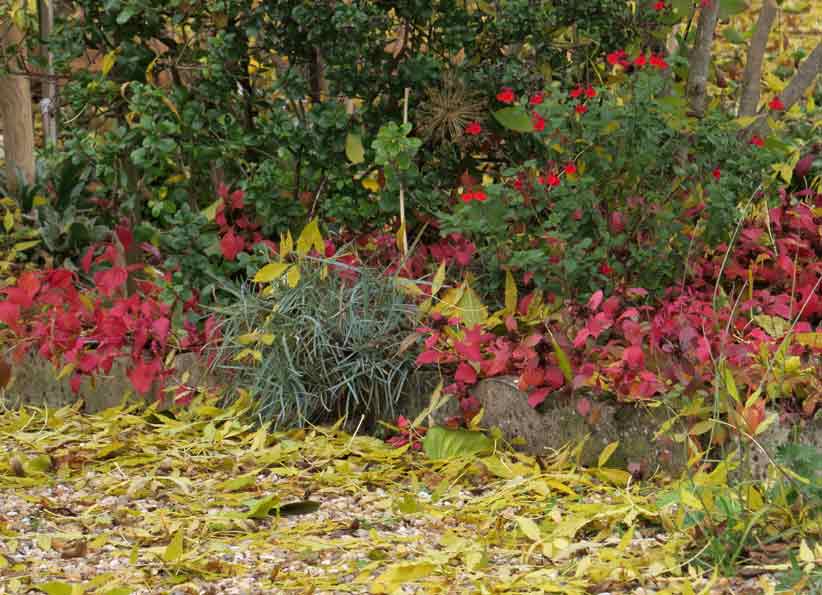
Frost is a perfect accompaniment to feathery grasses and unpruned shrubs adorning the lakeside. That blaze of colour I photographed in autumn has now subsided into a gentler picture of frost-rimed leaves and stems.

Over the years we've watched with great interest as Robert has transformed this hitherto closed-off area in front of his old flour mill - the 'Minoterie' as shown above - and created a path where neighbours like us can admire the changing seasons around the lake.

Balladin and Balthazar
As an added attraction, Robert also adopted some photogenic farm animals which may be familiar from my previous blogs!

One cold misty morning, he came to tell me he was going to ferry some feed up to the rare-breed sheep (mainly Soays) which run wild on his island.

This means taking the motorised oyster boat up-river, to an area of tall woodland bounded on all sides by a clear spring, or 'source', which brings our drinking water from deep inland.


misty river


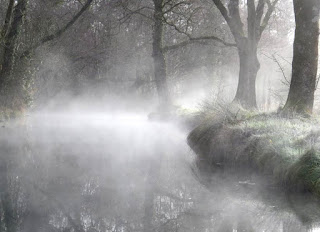
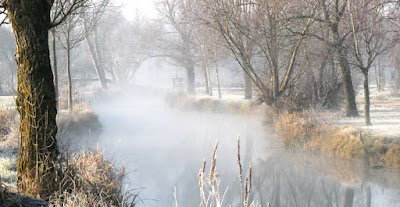
For me, sitting on a straw bale beneath the wheelhouse, this was a perfect oportunity to take some low-angled shots of mist rising off the water as we chugged through an eerily silent landscape, with just the odd moorhen skittering to safety as we passed.


misty river


It reminded me of the Cambridgeshire fens at a similar time of year... ice-cold but infinitely mysterious, especially when we entered the tunnel of overarching trees.


Wild sheep awaiting their supplementary rations
Disembarking on the island always sends the sheep running for cover, even though they must know it means extra food. I watch and wait quietly, hoping they'll get used to my presence and become more interested in feeding; but it takes a long lens to finally catch a few shots as they emerge hesitantly from the woodland.


misty river

Then it's back on board for an even colder ride back down-river, occasionally illuminated by sun breaking through the mist.


Swan photographed through red stems
of Cornus sanguinea
A pair of swans landed on the lake recently and have now taken up residence, ruthlessly sidelining the geese and ducks who were there first.

Fortunately there's enough space for them all to cohabit without too much hissing, and they probably appreciate the bits of stale bread which come their way most mornings!


Greenfinch at bird-feeder
Greenfinch
Without doubt it's the wildlife as much as the plants which makes a garden come alive and, despite my complaints about birdseed taking root in our driveway, it's always a pleasure to see them tucking in on a cold day.

Greenfinches turn into bullies, forever knocking the poor tits off our sunflower feeder. Sparrows hunt for seeds and crumbs in the driveway, along with the robin, dunnock and at least one pair of collared doves.


Collared dove - Streptopelia decaocto

I'm rather fond of the latter as they seem to be such affectionate, gentle souls, watching patiently from their usual perch on the power-line above our garden studio.

Sparrowhawk - Accipiter nisus - with prey
Sparrowhawk - Accipiter nisus
-
using its tail for balance


Unfortunately, they present a rather tempting target for any hungry predator like a passing sparrowhawk.

We've seen these hawks shoot out of nowhere with arrow-like precision, bringing down a bird which is almost equal in size.

A few years ago we watched in fascinated horror from our sitting room window as one such hawk carefully devoured a whole bird in front of us, pulling off clumps of feathers and eviscerating the poor, unwary dove.


Sparrowhawk - Accipiter nisus
Handsome but deadly...

It goes to show that gardens of all sorts can provide photo-opportunities and magical scenes even in the depths of winter. 


Long-tailed tits
A host of long-tailed tits decorating a tree
(with thanks to Photoshop!)


Saturday, 31 December 2016

Winter Reflections

"I dream my painting and I paint my dream."
- Vincent van Gogh

Beth Chatto's water garden
Beth Chatto's water garden at Elmstead Market

Winter is certainly a time for dreaming - and reflecting on events and impressions over the past year.

Beth Chatto's garden centre
Neatly labelled plants at Beth Chatto's
garden centre
It was a kind of pilgrimage for us to finally arrive at the former home of that doyenne of English gardening style, Beth Chatto.

We were on our way to visit Christina's cousin in Suffolk, having braved the M25 for the first time in 14 years, and reckoned this might be our one and only chance to see the famous gardens and plant centre at Elmstead Market.


Gravel-loving succulents at Beth Chatto Garden Centre
Gravel-loving succulents to tempt the eye
An eye-catching display of echeverias and sedums was almost the first thing to greet us on arrival at the garden centre...

What better use for all those ancient, spider-infested terracotta pots we'd been hoarding?

They might be useless for thirsty seedlings, but for designer-succulents sunk in gritty compost they are absolutely perfect!  We chose a few in 'hommage' to Beth's inspirational book on gravel gardening and have brought them home to admire through the winter.


Succulents grown in gravel
Clockwise from top left:
Hebe pagei; Sedum Cape Blanco; Sedum dasyphyllum;
Raoulia australis lutescens
group;
and (centre) Limonium bellidifolium

For the time being, we've grouped these together in an old copper pan, to complement its bluey-green verdigris; but later we can transplant any offshoots into individual clay pots and make another display.

Despite an icy autumn wind blowing off the North Sea, we enjoyed strolling through Beth's garden centre which is zoned into different areas, providing a short-cut for those of us with a particular soil type. Her restaurant and tea room are warmly recommended as a culinary haven on a cold day!


'prairie planting' at the Beth Chatto gardens
Archetypal 'prairie planting' at the Beth Chatto gardens
Inspiration comes almost subconsciously from visiting gardens, looking at artfully arranged photo-shoots in magazines and from certain historical styles such as the parterre... 

Cherry Garden at Ham House, London
Part of the Cherry Garden at Ham House, London,
with statue of Bacchus as a centrepiece
All that careful clipping of santolina, lavender and box would be a near impossible task for the amateur; but with battery-operated cutters it's not unfeasible to create something on a smaller scale.

It demonstrates in a very striking way the appeal of repeated design and understated colour, allowing light to be paraded as form.


Tuberose - Polianthes tuberosa
Polianthes tuberosa -
a heady scent from times past
Andrea volunteers as chief propagator at Ham House (run by the National Trust) and is always on the lookout for plants which would have been known in the 17th century when the gardens were laid out.

On our tour she showed us this statuesque lily-like flower being grown in a pot. Known as the 'tuberose' and used for centuries in perfumery, it's not a rose at all but a tuber related to agaves, native to Mexico and producing clusters of waxy flowers on spikes up to 45cm long.

Its fragrance is unforgettable and I've looked up a supplier online as it's unlikely to appear in a garden centre around here.


Olive pots at Petersham Nurseries
Classic ochre pots, tastefully
displayed at Petersham Nurseries
Walking back down the Thames towpath from Ham, Andrea took us on a detour to Petersham Nurseries... not just a plant centre but a wedding venue, and not simply a cafe but a Michelin-starred restaurant.

As a thriving temple to the art of shabby-chic, it doesn't disappoint! This is a style which still thrives in parts of France, particularly Provence where there is more of a Roman influence, but has yet to make a comeback in the garden centres of Charente Maritime.

If you're lucky, these half-glazed olive pots can still be found at local brocantes - but you'll need to haggle! 


Glazed pots at Petersham Nurseries
Green glazed pots as a foil for begonias
The seemingly casual displays at Petersham remind you of how important it is to match a plant to the right pot.

These dark-leaved begonias would look unappealing against terracotta, but a contrasting pale glaze shows off their colour and shape to perfection.

I particularly hate the craze for those plastic pots in fluorescent lime green or fuschia which are ubiquitous in French garden centres.

Maybe they look effective on a balcony or in a small courtyard, but in rural areas they're about as subtle as a flamingo set amongst lapwings, crudely clashing with whatever poor plant has been stuck on top!


Selection of pots at Petersham Nurseries
Pots that won't detract from flowers and leaves


Scotney Castle, Kent
Romantic 14th century Scotney Castle in Kent
Somewhere which was bound to make us feel nostalgic for England and the 'Garden of Kent' was Scotney Castle.

We stayed with another cousin - Barbara - in nearby Tunbridge Wells and she treated us to a day out visiting two of the National Trust properties with photogenic gardens.

Plant display at Scotney Castle, Kent
A seasonal display of plants and shrubs

As with Beth Chatto's enterprise, a real effort has been made to provide clear and interesting information for both the novice and more experienced gardener.

(Visitors ask the same questions all the time, so why not make things like plant names as visible as possible?)


Aside from the naturalistic gardens around the part-ruined castle, lake and moat, there is also an extensive nursery which is well worth exploring.


Dahlia 'Twyning's After Eight'
(with RHS Award of Garden Merit)
When we were there in early October, a host of different dahlias were coming into bloom and I have to admit that even the most garish of them look fabulous when grown en masse in a riot of colour.


If I could opt for just one, I think I'd pick this more restrained white variety with its single flowers up to 8cm across, and dark almost black foliage. Yum!

Now that Chiltern Seeds new catalogue has arrived, we're all set to dream away those long winter evenings...


Swan in mist


Wednesday, 30 November 2016

November

"There is a harmony
In Autumn, and a lustre in its sky..."

- Percy Bysshe Shelley


Such a spectacular autumn this year, lasting a full month from mid-October and all the more colourful for there being so many leaves hanging onto the trees, despite a dry spell at the end of summer.

Viburnum opulus
Viburnum opulus
Viburnum opulus

Also known as the 'snowball tree' for its white blooms, this was quite late in producing an array of subtle tints after many other trees had already shed their leaves.

The various types of ash growing locally were particularly vivid in their shades of yellow and we've been sweeping up leaves for the past month, filling both leaf bin and compost heap - all contributing to useful humus for future plantings.


Autumn colours in the garden
Fallen ash leaves contrasting with the
wine-red foliage of hardy plumbago
Unfortunately we've come to the conclusion that Ceratostigma plumbagnoides, that pretty blue-flowered hardy plumbago which does so well in dry unforgiving soil, is just too invasive for our small garden.

As with many ground cover plants, it served a useful purpose in providing colour when the beds were getting established, but is now leaching both space and nutrients from other desirable specimens which need a more 'careful' upbringing. Yes, we're getting more discriminating these days!

Physocarpus opulifolius

This may well be the variety 'Diabolo', which is described as "a stunning, multi-stemmed deciduous shrub", and is not necessarily something we would have heard of - let alone chosen for the garden - until recently when realising we needed more contrast in terms of leaf colour.

Although it's said to prefer acid soil, we've planted it in quite a chalky area and it's still thriving after two years.

Its leaves can appear almost black or bronzy red, depending on the season; you can cut it to the ground in early spring if you want to keep it compact, otherwise it can soon reach three meters in both height and spread.

Helleborus foetidus 'Miss Jekyll's Scented'
Helleborus foetidus
'Miss Jekyll's Scented'
Helleborus foetidus 'Miss Jekyll's Scented' - now here's a plant with really black foliage!

Again, I hadn't appreciated that fact when I grew it from seed a couple of years ago, as I was more intrigued by the prospect of having a perfume like mahonia wafting through the garden. (So promised my favourite catalogue supplied by those poetic folk at Chiltern Seeds ☺)

As yet the flowers haven't fully opened but the slow evolution of this statuesque specimen has really piqued my interest, especially as it's decided to bloom now when everything else is dying down.


Salvia elegans
Slow-burning Salvia elegans
That doesn't apply to the amazing South American salvias which only began blooming about six weeks ago, despite two of them being in almost permanent shade now.

These plants are usually hardy down to -6'C but it's probably a good idea to grow (and protect) some cuttings - if you can actually find any suitable non-flowering shoots!


Acer Palmatum
Still turning - Acer Palmatum
Determined not to be outdone, at the other end of the garden our Japanese maple is finally putting on its autumn coat, having stayed green for an unusually long time.

Last year it went red in August, seemingly as a result of being stressed in hot weather; but now it's clearly much happier having been sunk - still in its pot - into a raised bed of deep soil.


Camellia sasanqua
Camellia sasanqua

In a corner of the woodland area which still gets some afternoon sunshine, we planted a beautiful autumn-flowering Camellia sasanqua given to us by friends a couple of years ago.

I think it's probably a variety called 'Plantation Pink' and we were a little disappointed to begin with as it was slow to flower, despite being potted in ericaceous compost. But, again, it seems to be proof that some perennials just need to be in the right location in order to thrive.

Although soil here is still a bit on the chalky side, we planted it in humus under the large ash tree, next to other woodland plants like foxgloves, and it has already rewarded us with a succession of blooms.

The Strawberry Tree - Arbutus unedo
The Strawberry Tree - Arbutus unedo -
another woodland shrub, grown under the ash canopy

Viola x Wittrockiana 'Cats Mix'
Pansies
Like these F1 hybrids grown from seed, certainly help to brighten a shady garden in winter.
Worth ordering from Chiltern Seeds!


Ornamental grasses in autumn
The edge of our neighbour's lake -
showing just how beautiful grasses can be in autumn
Les Monards -  mist over the marais
Morning mist over the marais -
with reeds and teasels in the foreground

Two good reasons for getting up early on a cold November morning!


Monday, 12 September 2016

September

"We never know the worth of water till the well is dry"

- Thomas Fuller, 1732

Cote Sauvage, Charente Maritime
A welcome sight on another hot afternoon

We did think that once August was over we'd be able to enjoy the relative coolness of September... but not this year, apparently!

High daytime temperatures have continued into another week; our 'run-off' well and the rain butt have both been dry for some time; now there's no choice but to turn on a tap and use the watering system occasionally.

Oak Eggar moth
At least our nights have been comparatively cool so the plants have a chance to recover, and early morning provides our best chance of doing some gardening.

Hot weather always brings out a few interesting insects and we admired this attractive and furry Oak Eggar moth resting in a window recess.

hardy plumbago (Ceratostigma plumbaginoides)
Brimstone butterfly feeding
on hardy plumbago
The pale yellow butterfly on the right is a frequent visitor in September, drawn to the hardy plumbago (Ceratostigma plumbaginoides) and other blue flowers.

My book tells me that such a "buttery yellow fly" may have been the inspiration behind calling these fluttery creatures butterflies.

(As this fellow appears green in some lights, it may in fact be a Cleopatra rather than a Brimstone... they're hard to tell apart!)


La Maree garden
Herb bed with flowering hyssop and salvia

On the left of this picture are the cloudy pink heads of Sedum 'Matrona', which we've found to be one of the best sedums for attracting bees and hoverflies. (Its fleshy stems and leaves can look untidy, so perhaps it's not best at the front of the border.)

The rosemary you see here on the mid-right (above) is one we grew from a cutting and Christina is keeping it carefully trimmed to form a columnar shape. As we're unable to grow cypress trees here, I'm keen to find out just how tall she can get it :-)

Cerastium tomentosum and Dianthus plumarius
Silvery foliage of Cerastium tomentosum and Dianthus plumarius

Plants with silver leaves withstand dry conditions very well, although they'll produce more flowers with the occasional drop of water.

We also discovered that lavenders planted in semi-shade will bloom a couple of months later than usual and their nectar seems to be much sought after by butterflies visiting us now in late summer.

Hibiscus flowering with heleniums and rudbeckia
Hibiscus flowering with heleniums
and rudbeckia
Hibiscus is another plant whose flowers can be delayed when it's sited in a shady area.

We were drawn to this variety with white petals, blotched with a maroon centre, and took some seedlings from a friend's garden. (It's a plant which sets seed easily, particularly in sandy soil.)

White blooms always stand out well in dark corners; here they make a bright contrast with the ubiquitous autumn tones of orange and yellow.

Our other more mature hibiscus shrubs are practically trees now, sited in the front south-facing garden, and have all but finished flowering.


Salvia farinacea 'Fairy Queen'
Salvia farinacea 'Fairy Queen' 

Another plant which is performing well in semi-shade is this little Salvia farinacea from Chiltern Seeds which I sowed on a window sill at the end of March. When in bud, the stems look just like emerging spikes of lavender, but they soon open out into pretty blue and white flower heads.


Hydrangea 'Early Sensation' with Japanese anenomes
Hydrangea 'Early Sensation' with
Japanese anenomes
Hydrangeas have suffered from the intense afternoon heat but we've tried to help them by putting a layer of leaf-mould around their roots.

They definitely prefer a shady area and we took care to plant them below the tall barn wall where other shrubs might find it difficult to thrive. As the soil is very chalky there, we occasionally have to water in some Sequestrene (chelated iron) to stop their leaves from turning yellow.

Anenome japonica 'Honorine Jobert' also does well in this border and looks rather fetching amongst the fading pinkish blooms of Hydrangea 'Early Sensation'.


Pennisetum alopecuroides 'Chinese Fountain Grass' with Rudbeckia hirta

Grasses, of course, blend happily with almost any flower, diffusing and enhancing the bold colours of popular 'prairie plants' such as rudbeckia and echinacea.

Maybe I'm biased because I love the effects of filtered light when I photograph the garden, so I wouldn't be without some kind of ornamental grass even though it can take up valuable space and look quite boring for much of the year! 


Late summer blooms
Sunny rudbeckia with Salvia 'Black & Blue', Catananche caerulea,
Caryopteris clandonensis
and Verbena rigida
Christina enjoys picking a few seasonal blooms to decorate the table and I particularly liked this combination of yellow and blue - plus a bit of mauve from the verbena.


Veronica longifolia 'Blue Shades' and Echinacea purpurea
Veronica longifolia 'Blue Shades' providing contrast
to the mature blooms of Echinacea purpurea

This handsome veronica is another plant from Chiltern Seeds which I grew earlier this year and is flowering away in borders and pots.

When the sun continues getting hotter and hotter throughout the afternoon, there's only one place to go...

Surfers on the Cote Sauvage

Plage des Vergnes, Charente Maritime
... and with nightfall comes a cool breeze at last!