Friday, 19 May 2017

Mid May

"Splendor of ended day, floating and filling me!
Hour prophetic - hour resuming the past!"

Walt Whitman - Song at Sunset

A welcome for the new French president perhaps ...?

I've departed from my usual gardening quote for two reasons: one strirred by the accidentally patriotic image I came across amidst all our brightly flowering dianthus (yes, we hope it's an 'hour prophetic' this time!), and the other being that 'splendor' of sunny evenings, when stems and flowers are highlighted in a golden wash, irresistible to the camera.


Garden pictures
White Armeria maritima providing
a foil for pink dianthus
White and blue flowers stand out well in late afternoon but it's important to use the right camera setting in order to expose for subtly shaded petals and not for those shadows behind, which become less distracting when they appear darker.

Sunlight can be so intense here that plants simply merge into one another in the middle part of the day - a particular problem when your garden is bursting with flowers, all jostling for pole position!

The bright blooms of geum, geranium and dianthus are spread throughout our cottage-style bedding and they each come to prominence at different times of day, making it important to stroll around and appreciate a new picture every few hours.


After their first outing on the water, maman
encourages them back to their nesting site
Swan song
In between, it's also necessary to check on the progress of local wildlife, like the pair of swans I've featured in recent months.

They began nest-building beside Robert's lake in early March and we finally saw the female brooding on 24th March.

Her mate seemed to keep his distance most of the time, flying off every evening to spend his nights elsewhere... the cad!

After many visits to check on her progress, we were getting worried that she could well die of starvation before any of the eggs hatched.  Eventually, we got a late night email from Robert to say the babies were out and we should make haste to take pictures and videos.

By then it was May 3rd, yellow flags were out making a pretty picture beside the lake, and the male swan actually deigned to come and visit his new brood.


Eight cygnets paddling furiously in their mother's wake

But, sadly, that was the last we saw of them all!  According to Robert, the whole family disappeared upstream soon afterwards and we can only assume that papa swan had been off finding a new - and hopefully safer - abode for his chicks.


Foxgloves with blue aquilegia
Good companions
I think we must have at least half a dozen varieties of Digitalis purpurea on display now, although some of them have fared badly due to a sudden hot, dry spell which left them with tiny flowers.

I hate to see a plant in distress - if it's too late to help with water, best to cut it down! In the case of foxgloves you might be lucky and get more flower spikes if there's some decent rainfall.

Christina took similarly drastic action with some of the aquilegias which were producing masses of foliage earlier in the season. She chopped them back, flower stems and all, with the result that they came up with more blooms and less leaf second time around!


Geranium 'Azure Rush'
We also have at least ten types of cranesbill geraniums in various parts of the garden, many of the taller varieties combining well with climbing roses.

Some are better in part-shade, like this pretty and prolific flowering 'Azure Rush' which makes excellent ground-cover under a cistus bush.

Its blooms are very similar to those of the popular 'Rozanne' but it's more compact and lower growing.
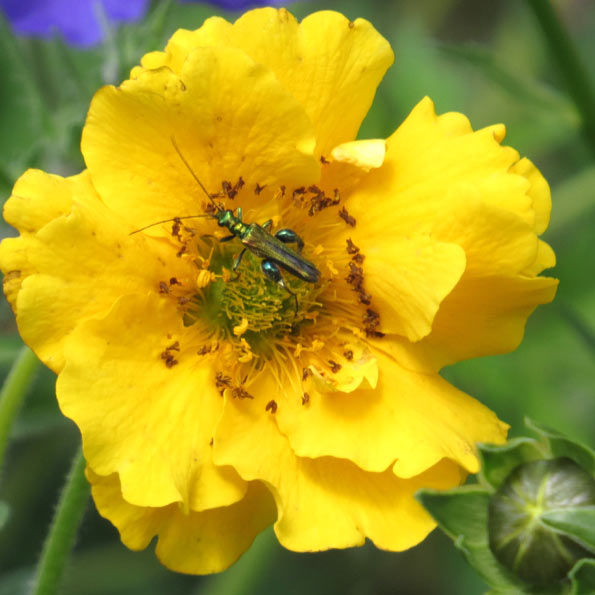


Geum coccineum 'Borisii' with
Oedemera nobilis beetle
And where there's a preponderance of blue flowers, as in our garden, it's always a good idea to fleck the ocean with touches of yellow and orange.

Some people grow English marigolds like weeds, providing lots of zing amongst the greenery; in our soil we seem to have more luck with geums and I love this one called 'Borisii' which is floriferous without being rampant. Unlike some others...

I've just had to cut down several stems of Geum chiloense 'Mrs Bradshaw' because her scarlet blooms were in danger of eclipsing everything else! 


Evening primrose
Moving on to more pastel shades, I love the flowers of this evening primrose because they're so luminous and delicately painted inside.

I grew this one from seed found in a friend's garden but unfortunately the foliage is rather limp and weedy so it can easily collapse in heavy rain.

Better I think to cultivate the rockery version, Oenothera speciosa 'Siskyou', which has very similar big flowers but a more creeping habit. It thrives in moist, well-drained soil in full sun.


Evening light on terracotta, with Echeveria 'Perle von Nurnberg'
in foreground and a Primula auricula flowering behind

Combining subtlety of colour with architectural shape, it's hard to beat sedums and echeveria hybrids, like the one above given to us recently by friends.

After a visit to Beth Chatto's Essex garden last year, we were inspired to resurrect some of our old pots to plant up with a selection of succulents. They provide interest throughout the year and are easy to manage in a courtyard garden - not much weeding required!

Since coming here and taking regular walks in the countryside, I've come to appreciate just how many plant shapes are based on the dandelion principle.


Tragopogon porrifolius
Tragopogon

Perhaps the most stately of these roadside weeds is a plant commonly known as Salsify, originally planted as a root vegetable in central Europe.

Its beautiful flower head only opens in the morning and has also given it the name 'Purple Goat's Beard', although I think it's more of a two-toned pink myself.

There's also a yellow version which is more abundant in our verges.

Both strains have magnificent seedheads and deserve to be even more widespread.


Tragopogon pratensis - three stages of a single plant


Viburnum sargentii 'Onondaga'
Shrubs
There's such an abundance of shrubs doing wonderful things in May that it's hard to pick out a favourite.

But every garden should have at least one member of the viburnum family and this was a cultivar I'd wanted to try for a long time.

We finally tracked down a small plant at a fair three years ago and it's now reaching maturity, 
about 1.5m tall and covered with exquisite lacecap blooms which later produce berries.

The only thing it lacks is scent and for that you need the early-flowering types like Viburnum carlesii.


Allium christophii a star emerging from its chrysalis
Alliums
It's taken a while to get alliums established in our garden and now they seem to be popping up everywhere.

Not so much in sunny open spaces, as you might expect, but in slightly shaded areas under shrubs.

Although we've tried a few different sorts, it's the 'Star of Persia' (Allium christophii) which is particularly at home in our soil, recklessly spreading its seed close to other established plants.

Allium christophii sharing the stage with yellow
evening primrose and blue geranium
As with many bulbs, it's interesting to watch the flower head emerging from its tight bud and acquiring its spherical shape.

Amazing that such complexity can be folded so neatly into a small space... it's true of all seeds, of course, but rather more spectacular to observe in an allium like this.

And those flowering 'stars' have a metallic sheen which reflect light and tempt one to take yet more photo's!


Baptisia australis
Baptisia
If you have trouble growing a flower that you're fond of, don't give up altogether but look around for another variety that might be more compatible with your soil or climate.

We managed to overcome the difficulty of raising lupins, which kept being eaten by snails, and turned to cultivating the perennial Baptisia australis instead.

Its blue pea-like flowers have given it the name 'False Indigo' and it's easily raised from seed.

These days you can get different coloured varieties, ranging from cream to yellow to apricot - very much like lupins really.


Our lettings cottage 'La Marée'
with magenta lychnis, blue larkspur and numerous pinks


Monday, 24 April 2017

Late April

"Time ceased, as if the spring
Had been eternity...
For ever, as of old,
The sunlight and the darkness and the singing."

- Ruth Pitter

Asphodels on the edge of woodland

It's that magical time of year when we pick a warm evening to visit the asphodel woods and I add to my picture files yet more images of these mysterious, ghostly figures haunting the shadows. In the distance, there's usually a nightingale's song or a cuckoo's call lending further enchantment to the scene.

charentefarmcottage.com
A bi-coloured hawthorn tree
A flush of warm weather at the beginning of April eventually gave way to days of piercingly bright sunshine and an equally eye-watering cold wind, thanks to the relentless north-easterly which scoured the fields white and tore young leaves from their branches.

Luckily most of our native blossom was tenacious enough to hang on, making a blinding display against blue skies.

The 'may' trees come out early here, decorating hedgrows and scenting the air with a slightly astringent tang that enlivens the senses.

Each day brings new surprises as soil spaces gradually fill up in the beds, lessening the opportunity for weeds to grow, and we struggle to recall exactly what is planted where.


Paulownia tomentosa aka the Foxglove Tree
Paulownia tomentosa
aka the Foxglove Tree
Our friends from a neighbouring valley, whose garden I photographed in March, rang to say that their paulownia was in full bloom if I wanted to take its picture.

This is already a tall tree with slender spreading branches and the brown buds have now opened to reveal downward pointing 'fingers' of lilac flowers, which are faintly scented.

Its leaves, too, are well-shaped with heavily etched veins adding to its exotic appearance.

Nearby was an ebullient lilac tree, covered in flowers of an almost identical shade. Last year our lilacs were noticeably lacking in blooms but they've more than made up for it this season and we've filled a succession of vases to enjoy the heady scent indoors.


More swags for the sitting room


Rose chafers (Cetonia aurata) on lilac
Rose chafers (Cetonia aurata)
Rose chafers

Our garden has always had an abundance of insects, including these emerald-green chafer beetles which buzz quite loudly when they're on the wing.

They don't appear to do any noticeable damage to our roses but we used to worry about the huge number of rose chafer grubs that were resident in our compost bin, having been told they were a pest which would eat through plant roots.


Rose chafer grub - a good guy!
In this regard, we're indebted to Chris Luck of the Anglo-French website Planetepassion for putting us right some years ago when he featured pictures of this useful grub, allowing us to identify it and appreciate how it benefits the garden.

Although our soil is extremely fertile, it's odd how few worms seem to live in it. Back in England we were used to digging up worms with every clod of earth. Not so here.

What worms we do have seem to originate in the leaf-mould bin, perhaps because it stays damp there whereas the flower beds are apt to dry out quite quickly in summer.

Chafer grubs, on the other hand, relish all the green waste in our compost bin and reward us by producing finely sieved 'black gold' for recycling in the beds. 


charentefarmcottage.com
Maturing compost, turned and mixed, with some
water added before being returned to the bin
(with grubs) for another few months of
natural break-down
Compost

Christina always dreads the moment when I suggest 'turning the compost' as she does most of the heavy forking, while I busy myself chucking out stones, walnuts, thick twigs and potatoes, which tend to grow shoots rather than break down efficiently.

It may take us a couple of days to finish the sorting process but it provides us with great satisfaction when we shovel the completed, crumbly compost into a fresh bin!


Walnuts


charentefarmcottage.com
Plenty of greenery now but walnut trees are slower to come into leaf


Early walnut leaves
If it wasn't for having a digital camera with a telephoto lens I might easily miss some of the finer details that nature provides when plants are waking up again.

I first noticed the colour of these emerging leaves when I was trying to focus on dangling walnut catkins which were then more obvious.

These striking tonal effects last but a day or two and need strong sunlight to show up the full range of tints. By next week they'll probably have succumbed to a uniform shade of green!


Quince blossom - Cydonia oblonga
found in orchards or even growing semi-wild
on the edge of local woods!

Quince

Not to be confused with Japanese flowering quince (aka japonica or Chaenomeles), this is a tree of the rose family which produces exquisite cup-shaped blooms.

Gardening writer Anna Pavord describes finding these blossoms for sale in an achingly trendy Fifth Avenue store, where they could be purchased for a mere $40 a branch!

Here in rural Charente Maritime they're usually grown for their pear-shaped fruits which are high in pectin and traditionally used for making quince jelly. They're also delicious when cooked up with apples.


Box hedge blighted by caterpillars
Caterpillars

Much as I love our insect friends, there are occasional infestations which prove they can sometimes be too much of a good thing!

Having avoided box blight over the past ten years, our little hedges have been quite badly affected by a moth caterpillar which spins webs between the branches and feeds off the leaves.

The RHS has a useful page on this particular pest, Cydalima perspectalis, which we first noticed last summer. We sprayed it with a product from our local store but unfortunately it came back this year, worse than ever.

So we've resorted to carefully spraying with Rose Clear Ultra, bought in the UK recently and probably banned in the EU...  Controversial, I know, but something I've used successfully on roses and other plants, in very localised situations. It may call for two applications to really eradicate the caterpillars this time.


Euonymus Caterpillar - Yponomenta cagnagella
Euonymus Caterpillar
Yponomenta cagnagella
We had a graphic illustration of just how bad these infestations can get if you don't intervene early enough.

Walking past a nearby hedgerow, where we regularly admire the bushes of spindleberry in autumn, we saw with horror how they were festooned with white webbing.

Closer inspection revealed that the webs were full of caterpillars with black spots, later identified as larvae of the European Spindle Ermine Moth, a well-known pest which can cover euonymus shrubs over a huge area.

Check out Google Images for some very scary photo's!!


Rose 'Astronomia' bred by Meilland
Rose 'Astronomia' - a newcomer
bred by French growers Meilland
Roses

On a calmer note, it's lovely to watch the first roses appearing in various parts of the garden, not just in sunny areas but also in semi-shaded spots beneath trees.

This is where the hedging rose, Rosa rugosa, comes in useful because it flourishes in sun or part-shade, tolerant of dry soil - and even, dare I say it, a certain amount of neglect!


Rosa rugosa
Rosa rugosa - robust, good for mixed hedges
and easily raised from rooted suckers
I've noticed a few aphids on some of its tough little leaves but they are soon shaken off and its buds don't tend to attract greenfly like other, more highly bred roses.

You can almost tell from looking at this flower that it will be beautifully scented... we have at least three varieties of rugosas and they are all strongly perfumed.

If I have any gripe, it would be that these velvety blooms just don't last long enough.


Popular on the seasonal menu... a tranquil early-morning scene!


charentefarmcottage.com
Marais lambs bred on salt marshes along the estuary


Thursday, 13 April 2017

Early April

"When daisies pied and violets blue
And lady-smocks all silver-white
And cuckoo-buds of yellow hue
Do paint the meadows with delight..."
- Shakespeare

Bank of oil-seed rape in countryside
Would the Bard have known about 'cuckoo-buds' of oil-seed rape?

What could be finer than setting out on a bright April morning, with the dew wet underfoot and leaves just beginning to unfurl their Spring green?


Cardamine pratensis Lady's Smock
Cardamine pratensis
Lady's Smock
Whilst some countryside plants will have changed since Shakespeare's time, many are reassuringly familiar - like the Lady's Smock or Cuckoo Flower on the right, which favours damp meadows and has been much in evidence these past three weeks.

It's common in wetlands throughout Europe and our local variety has a subtle tinge of mauve to its petals.

Certainly it's less obtrusive than the almost fluorescent blooms of rape seed, happily colonising banks and waysides from last year's crop!


Fumaria officinalis Common Fumitory
Fumaria officinalis
Common Fumitory
Despite its name of common fumitory, this fragile wildflower is less ubiquitous in our verges and vineyards but rather endearing once you look closely at its little spurred flowers in two-toned pink.

It would be great to find a taller, more stalwart version for the garden but the closest we've come is to grow the cultivated toadflax, Linaria purpurea, which is usually available in purple but can also be found in a pale shell pink; this variety is known as 'Canon Went' and has delicate foliage which easily fits between other stouter plants.


 Wildlife


Also full of the joys of Spring, our neighbour's newest donkey - Balthazar - decided to get frisky with his stable-mate, Baladin, who is a Poitou donkey almost twice his size.

Never mind that they're both males, it looked like simple horse-play despite all the biting and at one point little Balthazar ended up square underneath his friend... hours of fun and frolic!


Racka ewe and lamb
An elegant Racka ewe
poses with her lamb
Meanwhile, our local lambs have been growing up fast and there seem to be few left to gambol amongst the daisies.

One exception is our neighbour's rare-breed ewe, a Hungarian racka, which has just given birth to a curly-coated lamb with rather coltish legs.

Wikipedia tells us they are a multi-purpose breed, used for milking, wool and for meat, whilst their 'quiet disposition' makes them suitable for amateur
enthusiasts. (Over here, a local lady spins their wool to make some very appealing soft toys.)


Dicentra spectabilis or bleeding heart
Dicentra spectabilis
or Bleeding Heart
Perennials

This year our dicentra has obligingly produced its flowers so that they arch gracefully over the path, catching the early-morning light and creating an irresistible photo.

When you look closely, their blooms appear to be sewn from softly cushioned satin, and that little white drop at the bottom of the 'heart' often holds a bead of moisture, adding to its jewel-like effect.

We also grew a white version of the plant which is pretty but not nearly so eye-catching.

In the background are mounds of white iberis and mauve aubretia which provide useful edging.


Penstemon digitalis contrasting
with Lychnis coronaria
One of the best things about early spring is watching the emergence of bright new foliage on perennials which may have become a little ragged and browned-off over winter.

Lychnis is a plant which seeds itself all over the garden and I spend time removing many of its babies before they reach adulthood.

But here there's a happy combination, where it's found itself next to the claret-coloured foliage of penstemon 'Husker Red' and I can't bring myself to pull it out just yet!


Brunnera macrophylla
Brunnera macrophylla -
probably the variety 'Jack Frost'
Brunnera is an understated perennial but no less valuable for that as it stands out in the shade under trees.

Ours is currently blooming alongside annual myosotis, or forget-me-not, and you'd be hard put to spot the difference between their blue flowers.

But this brunnera has the added advantage of shapely silver-blotched leaves which still look pretty long after its flower-sprays have gone over and the dried up clumps of myosotis have been dispatched.


Plant Supports


From left to right: Peony, Anchusa azurea and Lavender


The willow supports that Christina wove together last month are starting to prove their worth now that perennials like peony and anchusa are growing fast.

We've also tried a simple version on one of the lavenders to try and keep its branches from splaying out. This happens quite often when a cat - not necessarily ours - decides to jump into the middle when giving chase to some luckless mouse.

The other option is to stick a thin bamboo into the middle of the bush but this might be dangerous if your feline gets carried away and fails to see it!


If you don't have enough walls, use tripods for
those roses which tend to have lax growth


Tulipa 'Ballerina'
Tulipa 'Ballerina' - still flaming brightly
Tulips

A sudden flush of hot weather has brought all the tulips out together, none more flamboyant than Tulipa 'Ballerina' which is in its third year now.

We've kept these bulbs in the same copper container through summer and winter, without doing much except giving them a feed and water from time to time.

Other bulbs which thrived in their first year haven't done so well in the second season and this might be because they sat in poorly drained soil during winter.


Tulipa clusiana 'Peppermint Stick'
Tulipa clusiana
'Peppermint Stick'

If the bulbs have small flowers but are still basically intact and healthy, it's always worth drying them out and replanting them in a sunnier, better-drained spot, giving them some fertiliser (like blood, fish and bone) to build up their vigour once more.

The species tulips, like Tulipa clusiana here, are meant to be petite and that's really the essence of their charm.

Being so small, they can easily be accommodated at the edge of a sunny border and just left to naturalise, returning at the end of March without fuss or fanfare.


Out and About

With days getting longer and evenings staying light until after 8 pm, there's more reason to go out walking and absorb all the sights and sounds of the burgeoning countryside.

The danger of stray hunters taking a pot-shot in the gloaming is thankfully past and animals like this normally shy roe deer are emboldened by the growth of lush grass to camouflage their movements.


Vines just breaking into leaf
Vines have reached that lovely stage when the first buds are breaking and downy leaves are fanning out to catch the sun.

It seems the red grape varieties are slightly in advance of the white and there's even a touch of pink in their buds as a foretaste of what's to come.

What started as a cold wet spring has developed into something full of promise for the weeks to come. Fingers crossed it lasts!


Perfect weather for sowing... will it be sunflowers this time?


Saturday, 25 March 2017

March

"And since to look at things in bloom
Fifty springs are little room..."

- A E Houseman

Amelanchier lamarckii
Amelanchier lamarckii - a graceful harbinger of Spring

Amelanchier

According to the RHS, this poetic-sounding tree is more generally known as 'Snowy Mespilus' thanks to its display of airy white blooms in late March.

Amelanchier lamarckii
Amelanchier lamarckii with wine red
Viburnum sargentii behind
In our garden it's a multi-stemmed shrub rather than a tree, which means you can watch each stage of development in close-up; not just that early froth of flowers but the unfurling of downy leaves which gradually progress in colour from copper to green to scarlet in autumn.

Even the delicate shape of its outline invites poetry: a haiku perhaps, or the fluid sweep of a Chinese brush dipped in ink. Those slender branches and flower pannicles seem to possess a dynamism that other blossoms lack.

And if that isn't enough to charm you, it also produces edible fruits like small berries which are quickly eaten by birds when you don't get there soon enough!


Swans on lake with weeping willow
Weeping willow or Salix babylonica
- first tree into leaf around here
Useful Willows

Around our neighbour's lake grow a number of different willows, both shrubs and trees, which have provided decorative stems of red and yellow throughout winter but now call for a sharp prune.

Some of the prunings from pollarded trees are at least two meters long and Christina has found them handy for weaving into plant supports.

Although the guides she looked at online suggested soaking these stems or 'withies' beforehand to make them more pliable, she was able to bend them into shape without doing so - perhaps because they'd only recently been cut.


Plant support made from Salix alba var. vitellina
Salix alba var. vitellina
- a very bright shade of yellow

This one was made-to-measure for a peony which grows quite big and tends to flop.


Obviously the uprights need to be long enough so that you can push them securely into the earth, particularly if you have a marauding cat like ours who indiscriminately scratches deep holes in flower beds.

Being fresh willow does also mean that they might well take root... watch this space!


Driftwood washed up at Talmont-sur-Gironde
Washed ashore in a winter storm
Flotsam
From time to time we scour the shore for pieces of driftwood to take home and decorate the garden, thereby supplying Couscous with a handy scratching-post for his claws.

This piece was certainly artistic but I'm not sure that even ten strong men would be able to lift it. Amazing how such huge pine trees find their way down the Gironde Estuary!


Sanderlings and ringed plovers
Since mid-March we've also been scouring the coast for newly-arrived birds such as swallows, but rainy weather and blustery winds appear to have delayed them this year.

We've had to content ourselves with watching flocks of sanderling and plover as they skitter back and forth at the water's edge.

Their white breasts catch the light beautifully as they turn en masse against a dark sky.


Stork platform near Les Monards
Storks checking a platform on the marais
Storks arrive!

There was a window of opportunity this morning when the sun came out and we took a walk across the rather boggy marais behind our house.

My aim was to photograph the lovely pear trees planted by our neighbour, Robert, most of which are in full bloom. Christina, meanwhile, was on the lookout for a nice bit of birdlife...


Stork on platform
Stork on platform
This platform was put up a couple of years ago by Robert, who already has another well-established nesting spot on his land which I've featured before on this blog.

We'd noticed storks investigating on a couple of occasions but none of them had actually taken up residence, despite it being sited near water but far enough from pathways and human habitation.

This time a party of five storks kept flying around but one pair in particular seemed to be trying to make a nest on the platform, so we'll have to keep an eye out for progress!


Pyrus calleryana in full bloom
Pyrus calleryana
-
the Callery pear flowering profusely
Ornamental Pears

In spite of those buffeting winds, our neighbour's pear trees have held on to their blossoms and we've been admiring them all week from our upstairs window.

Prunus calleryana, the ornamental pear, has a mixed reputation as it can be dangerously invasive in some parts of the US and is considered quite a pest, despite its beauty and usefulness as a shapely border tree.


Pyrus calleryana - colour in spring and autumn
- preferably sited in full sun with damp soil 
I'm not sure what these cultivars are called here in France but I see that the RHS recommends the named variety 'Chanticleer' for its conical habit and autumn tints.

The tree on the left produces glossy oval leaves which turn a fabulous dark red in November.

Its brown fruits, on the other hand, are small and insignificant - nothing like a real dessert pear!


The pear orchard with stork approaching (top right)


'Froggie' on his perch in the nectarine tree,
keeping watch for visiting insects
In our own garden we enjoyed some good blossom on the young nectarine tree growing in the shelter of a leylandii hedge, thus avoiding the worst of the cold winds.

With so much rain we worried that its flowers wouldn't get pollinated as there weren't many bees or other insects braving the elements.

Since our potted pieris was in full flower, Christina had the idea of moving it close to the nectarine so that passing insects would have a full 'nectar bar' to attract them.


Tulips

Tulipa turkestanica
The first of the tulips to come out is the starry little Tulipa turkestanica with grey-green foliage which sits well amongst clumps of dianthus edging our raised bed.
So many tulips have untidy, floppy foliage that we tend to keep most of them in pots. But these small, species varieties are more like crocus - opening up their throats to the sun, creating a splash of colour and then retreating without too much fuss as they gradually go over. They die down just as the dianthus springs into action.


Narcissus actaea - with some 'tulipes contre
le cancer'
that got separated from their bulbs! 
March is the month for cancer fund-raising in France.

Back in 1988 someone came up with a scheme for clubs and agricultural colleges to plant thousands of tulips which could then be harvested and sold together with their bulbs.

The French, and us gardeners alike, love nothing better than a good deal - and what could be better than actually enjoying the tulips before you plant them in your garden!

This year's colour is a warm shade of ivory which can be planted alongside almost anything but looks quite subtle next to a few white narcissi.


Wild flowers

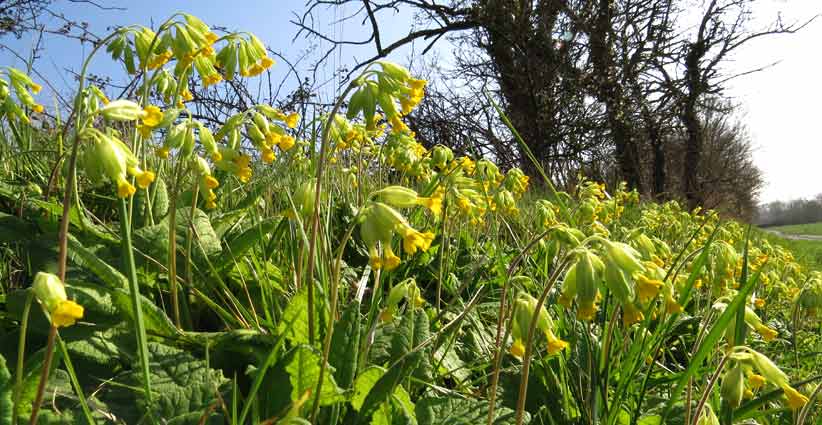
A bank of cowslips, increasing year on year


Much as we might complain about the wet spring, there's no doubt it produces more colour in verges, vineyards and meadows around here.


Cushions of daisies and marigolds between the vines